



Contract renewal deadline reference
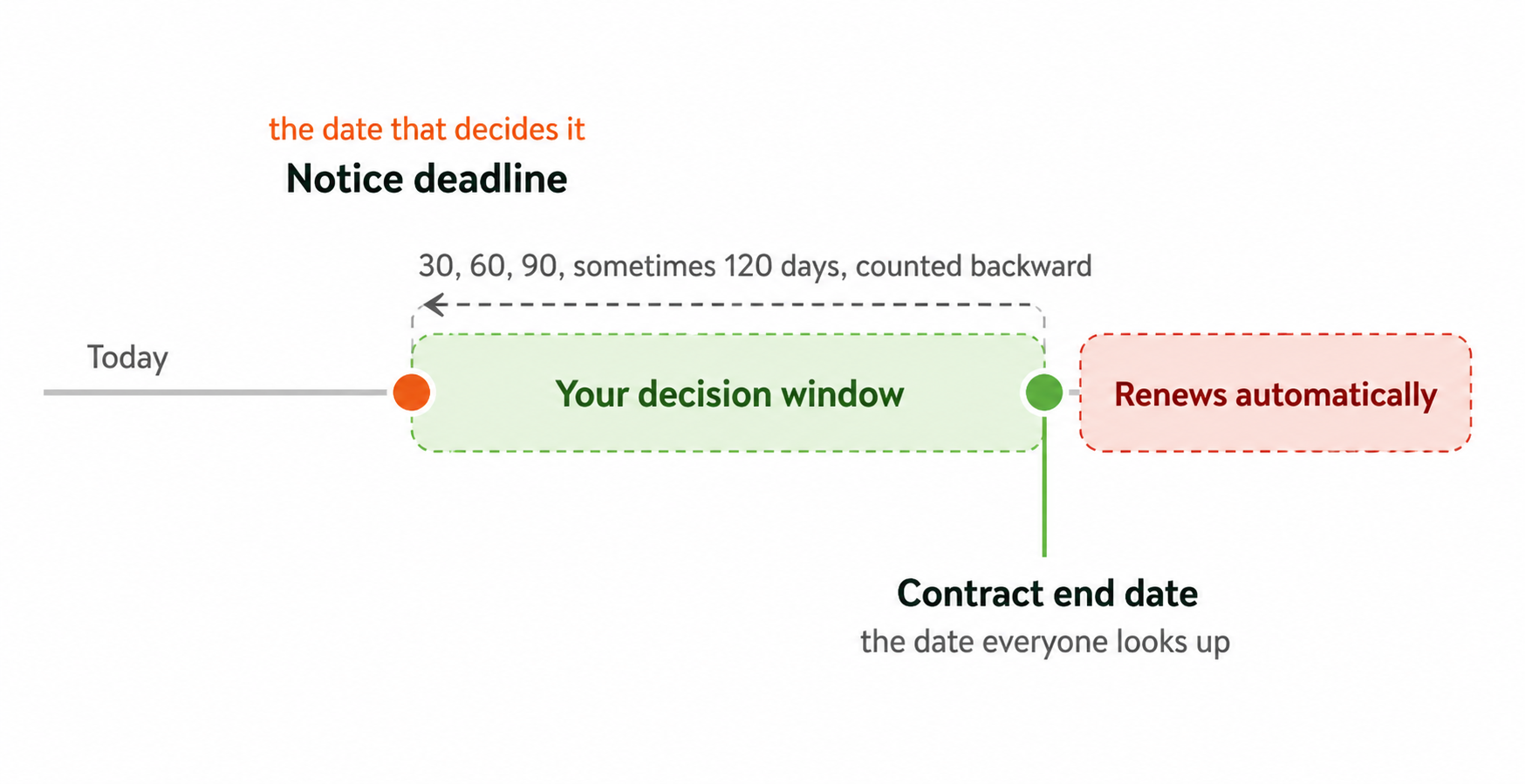
The deadline that actually decides things sits earlier than the end date. Miss it and the agreement renews on its own.
Find Two Dates, Not One
Everyone knows to look up the contract end date. The date that actually decides things is the cancellation notice deadline, and it lands earlier. Telecom and managed services agreements commonly ask for written notice 30, 60, or 90 days ahead of the end date, and some stretch to 120. There's rarely a grace period. Miss the deadline and the agreement renews, often for another one to three years, at whatever the new rate turns out to be.
Two details that trip people up. The notice period counts backward from your end date, not forward from the day you get around to sending it. And a very long window isn't generous, it's the opposite: a 120-day requirement forces you to decide before you've finished evaluating the term you're still paying for.
So pull out the agreement and write down both dates. If you can't find the notice language, that's a phone call worth making, and it's a question your provider has to answer.
You Probably Don't Have a Legal Safety Net
A lot of states have passed automatic renewal laws over the past decade, and they're getting stricter. Almost all of them are written to protect consumers, not businesses. Business-to-business agreements are mostly left alone, which means nobody is legally required to remind you that your window is closing.
Practically speaking, the contract is the rule. Whatever it says about notice is what governs, so the only reliable reminder is the one you set yourself. Worth confirming with your own attorney if a lot of money rides on it.
Five Things to Check in the Contract You Have Now
-
The renewal term. Does it roll month to month, or lock you into another full term? In telecom, another one to three years is common.
-
The notice requirement. How far ahead, in what form, and to whom. Some contracts only count written notice, and some only count certified mail.
-
Early termination fees. Often the remaining months on the term, and sometimes paying back discounts or waived installation costs on top.
-
What happens to the price. The provider-friendly version moves you to current list pricing at renewal. The buyer-friendly version caps the increase.
-
Equipment terms. What goes back, in what condition, and what they bill you if it doesn't.
Two versions of the same clause
| Clause | Provider-friendly | Buyer-friendly |
|---|---|---|
| Renewal term | Auto-renews into another full multi-year term | Rolls month to month after the first term |
| Price at renewal | Moves to current list pricing | Capped increase, or tied to inflation |
| Notice window | 90 to 120 days, written and certified | 30 to 60 days, written |
| Renewal reminder | None: remembering is on you | Provider notifies you before the deadline |
Questions Worth Asking Any Provider, Including Us
-
What is the upload speed? Download gets advertised. Upload is what video calls, cloud backups, and hosted phones actually lean on.
-
What happens to this price at renewal? An intro rate that jumps in year two isn't a lower price, it's a delayed one.
-
Who picks up when something breaks? Ask what support looks like after the sale, and who you actually reach.
-
How long is installation? Lead times decide when you can really switch, so ask before your window opens rather than after.
-
What does a backup connection look like? If an hour offline costs you money, ask what keeps you running through one.
Three Things Worth Asking for in the Next Contract
These are all negotiable, and asking costs nothing. Even a partial yes leaves you better off than the default paperwork.
-
A written renewal reminder. Ask that the provider notify you before your notice deadline, and that missing it extends your window. This moves the burden of remembering off your desk.
-
A cap on renewal increases. A fixed percentage ceiling, or one tied to inflation, instead of open-ended list pricing.
-
A shorter notice window. Thirty to sixty days is a reasonable ask. Anything past ninety mostly benefits the other side.
A Rough Order of Operations
Common Questions
How much notice do I have to give to cancel?
It depends on your contract. Most ask for 30, 60, or 90 days before the end date, and some telecom agreements ask for 120. The exact number lives in the cancellation or termination clause.
What happens if I miss the cancellation deadline?
The agreement usually renews on its own, often for another one to three years at whatever the new rate turns out to be. Most contracts don't build in a grace period, so a day late is late.
Can a business contract renew automatically without anyone telling me?
Yes. Automatic renewal laws in most states are written to protect consumers rather than businesses, so nobody is legally required to remind you. Whatever the contract says about notice is what governs.
Can I negotiate the auto-renewal terms?
Yes, and asking costs nothing. The three most useful asks are a written reminder before your notice deadline, a cap on how much the price can rise at renewal, and a shorter notice window.
Not Ready to Switch? Let's Start the Clock Anyway.
Most businesses can't move until their current contract is up, and most contracts quietly auto-renew if you miss the notice window. Tell us roughly when yours ends and we'll make sure you don't.