


100%
Fiber. 0% Fake Fiber.
Always Fiber.
Always Local.
Never Half-Fast.
It’s time for an internet provider that doesn’t cut corners on your connection or your community. Experience 100% Fiber with support from your neighbors. Real speed. Real local. Done right. Every time.
Check fiber availability
Checking availability...
Cable wasn’t built for modern life. Fiber was.
The term outdated doesn’t even come close to describing cable. Yesterday’s systems can’t handle today’s uploads, video calls, gaming, smart homes, cloud backup, and file sharing needs. Translation? Capacity is limited and the lag struggle is real.

Internet Plans Built For You.
Symmetrical upload and download speeds. No data caps, no contracts, and no hidden fees.
Essentials
Affordable internet for a seamless online experience.
- 500 Mbps equal upload and download speeds
- Reliable, seamless streaming
- Smooth browsing & scrolling
- Great for everyday use
Included with this plan
- Blast Wi-Fi Router The ALLO Blast Router delivers LIGHT-ning fast speed throughout your home with the latest Wi-Fi 6 technology. Dual-band Wi-Fi 6 technology helps you stream simultaneous data and support multiple users on over 250 devices. The ALLO Blast is included for FREE for all 500 Mbps customers.
- ExperienceIQ ExperienceIQ provides even greater network control. Set up content filters, block specific apps or sites, set up device specific time limits and more!
- ProtectIQ ProtectIQ adds an extra layer of security at the router level, which means safer surfing on all your devices. It blocks malicious content, scans for viruses, and alerts you right away if any suspicious activity occurs.
- SmartTown SmartTown provides ALLO customers with community-wide Wi-Fi on the go. Once you join SmartTown and onboard your devices, you will automatically connect to SmartTown Wi-Fi, where it is available. This means walking around your neighborhood, to school, or at the park, your devices will be connected.
Add DIRECTV streaming
Add Mobile and/or Home Phone
Pro
The sweet spot for work, play, and everything in between.
- 1 Gig equal upload and download speeds
- Instant large file downloads
- High bandwidth for multiple devices
- Crystal-clear video calls
Included with this plan
- Blast Wi-Fi 7 Router
- ProtectIQ ProtectIQ adds an extra layer of security at the router level, which means safer surfing on all your devices. It blocks malicious content, scans for viruses, and alerts you right away if any suspicious activity occurs.
- SmartTown SmartTown provides ALLO customers with community-wide Wi-Fi on the go. Once you join SmartTown and onboard your devices, you will automatically connect to SmartTown Wi-Fi, where it is available. This means walking around your neighborhood, to school, or at the park, your devices will be connected.
- ExperienceIQ ExperienceIQ provides even greater network control. Set up content filters, block specific apps or sites, set up device specific time limits and more!
Add DIRECTV streaming
Add Mobile and/or Home Phone
Max
Serious speed for serious power users.
- 2 Gig equal upload and download speeds
- Lowest latency for elite gaming
- Seamless 4K & 8K streaming
- Powerful multitasking
Included with this plan
- Blast Wi-Fi 7 Router
- ProtectIQ ProtectIQ adds an extra layer of security at the router level, which means safer surfing on all your devices. It blocks malicious content, scans for viruses, and alerts you right away if any suspicious activity occurs.
- SmartTown SmartTown provides ALLO customers with community-wide Wi-Fi on the go. Once you join SmartTown and onboard your devices, you will automatically connect to SmartTown Wi-Fi, where it is available. This means walking around your neighborhood, to school, or at the park, your devices will be connected.
- ExperienceIQ ExperienceIQ provides even greater network control. Set up content filters, block specific apps or sites, set up device specific time limits and more!
Add DIRECTV streaming
Add Mobile and/or Home Phone
1 of 3
Better Internet for a Better Commuinity.
Rely on ALLO Fiber to deliver better experiences with real support from with powerful connectivity that moves your family forward.
Upload = Download
Experience seamless video meetings, backups, file transfers, and live streams.
Dependability That LASTS
Count on consistent performance with fewer slowdowns, less interference, and more stability.
Faster. Longer. Stronger.
Send and receive more data, carried over longer distances, with virtually no signal loss.
Future-Proof Infrastructure
Demand more from fiber built for massive two-way data, ready for tomorrow’s devices, apps, and bandwidth needs.
Lower Impact on Environment
Support conservation with fiber that efficiently transmits data via light, requiring less energy.
Potential Home Value Increase
Make your home more attractive to buyers and increasingly seen as future-ready.
100% Fiber vs. Fake Fiber
Fiber is the only choice for your modern connected life.
| Feature |
|
Cable |
|---|---|---|
| Uploads = Downloads Speeds |
|
|
| Direct Fiber to Home |
|
|
| 100% Fiber Network |
|
|
| No Data Caps |
|
|
| Upload Performance | Excellent | Limited |
| Peak-Hour Consistency | Excellent | Variable |
| Interference Issues | Minimal | Prone |
| Future-Proof Network | Legacy Limits |
Find Your Local Store
Real Fiber. Real People.
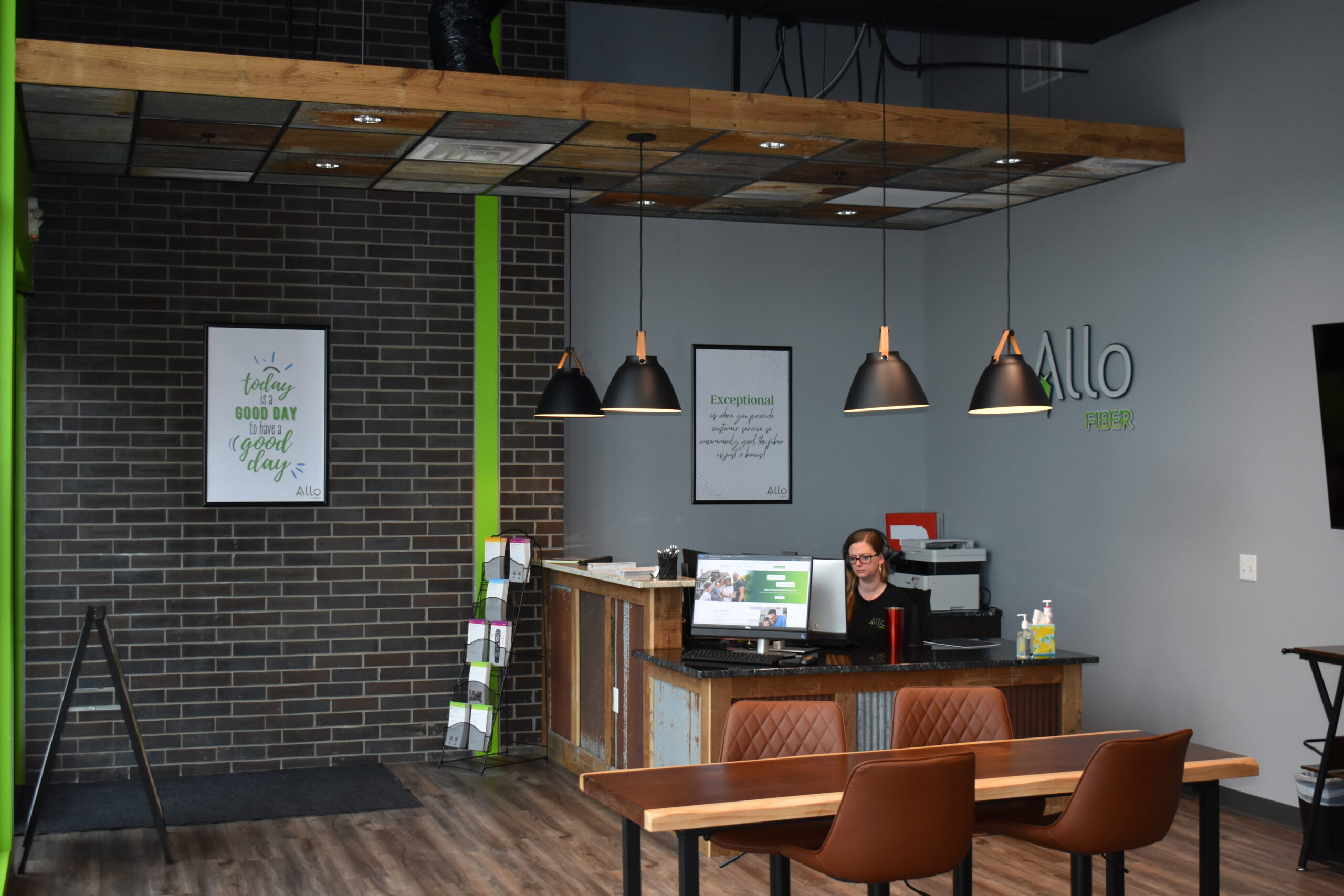
At ALLO Fiber, we don't do anything half-fast. We offer 100% real fiber and real human support that serves the community, from the community. While other providers manage your connection from a distance, we’re right around the corner, invested in your neighborhood and ready to help.
Fiber’s Performance Isn’t Just Marketing.
It’s Measured.
Modern fiber standards like XGS-PON are defined as 10 Gbps symmetrical networks, built for equal upstream and downstream capacity. Cable networks were historically designed with heavier downstream allocation.
Independent broadband testing (FCC’s Measuring Broadband America) shows fiber networks consistently delivering lower latency and more reliable performance compared with cable and DSL in real-world conditions.
Consumer broadband analyses confirm fiber’s strength in symmetrical upload performance and lower latency compared with cable services, especially important for video conferencing, cloud backups, and real-time use.
Independent broadband performance comparisons show fiber optics typically delivering consistent speeds and responsiveness even during peak usage periods, compared with legacy copper-based technologies.
Fiber optics transmit data as light through glass strands and are inherently immune to electromagnetic interference — a key advantage over copper-based cable systems.
Source: Why Fiber Optic Cables Outperform Copper in EMI-Prone Environments
Upgrade to ALLO’s 100% Fiber Network
Because if your internet is behind the times, so are you.